




 Blog
Blog
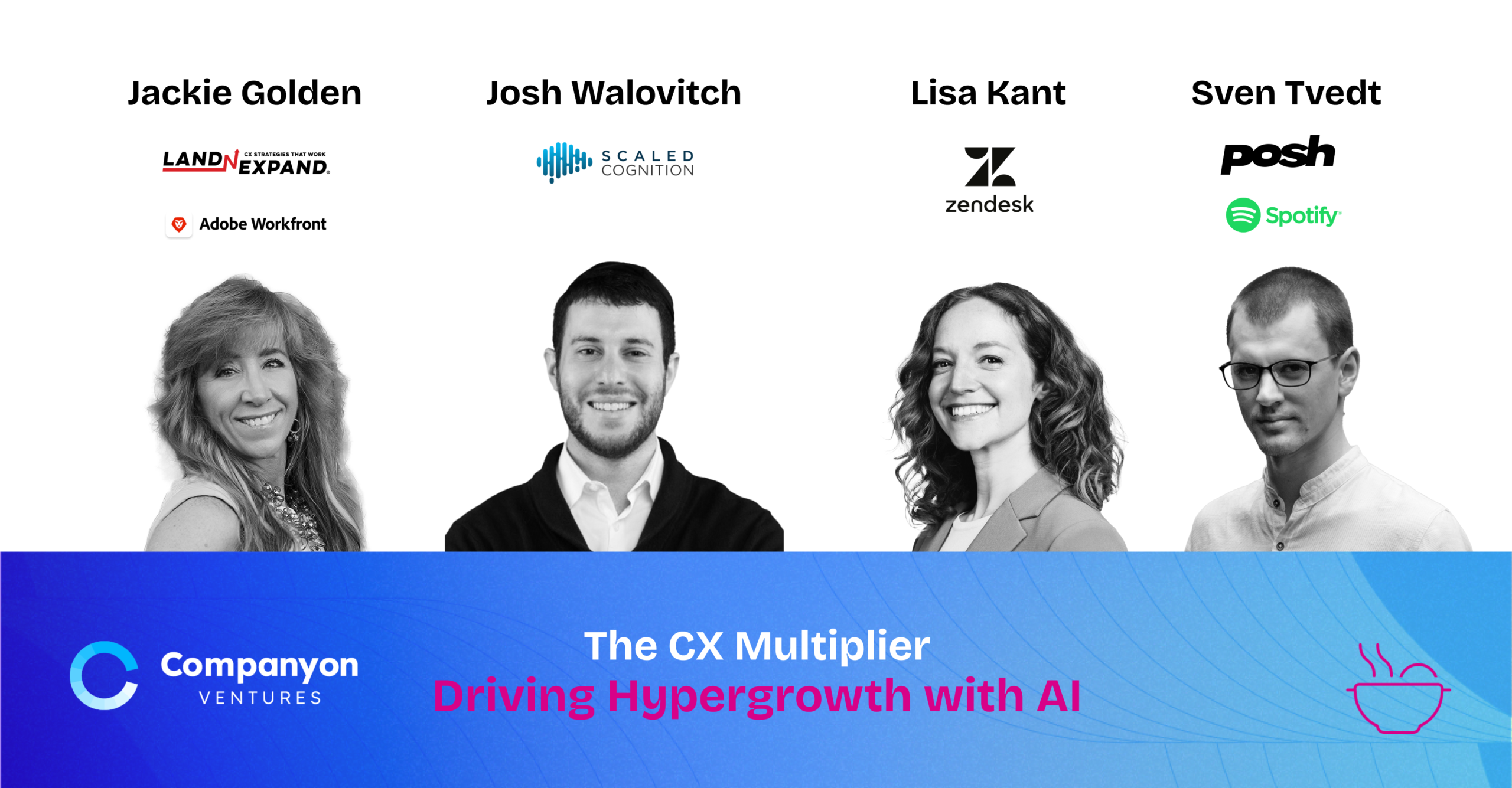
The CX Multiplier: Driving Hypergrowth with AI
As your customer base scales, managing the customer experience becomes exponentially more complex. The challenge isn’t just acquiring customers—it’s delivering consistent, high-quality experiences at scale.
Companyon brought together industry leaders to compare and contrast three distinct approaches to implementing AI in customer experience—from leveraging proven commercial platforms with new AI capabilities, to building custom agentic AI solutions, to embedding AI directly into your product. Each approach offers distinct advantages in terms of growth, cost, and competitive differentiation.
 Companyon Venture Partner, Jackie Golden, helps software and AI companies scale from founder-led to professionally-led businesses by building lean, AI-powered growth engines. Jackie hosted an expert panel representing these three different, but complementary approaches:
Lisa Kant, SVP of Product and Field Marketing at Zendesk. Lisa leads product marketing for Zendesk’s AI-powered Resolution Platform, which now generates nearly $200 million in annualized AI feature revenue.
Sven Tvedt, Engineering Manager at Posh and former Engineering Manager at Spotify. With experience building platforms for millions of users, Sven discusses how to build AI-enabled CX into your product experience.
Josh Walovitch, Director of Marketing at Scaled Cognition, introduces Agentic Pretrained Transformers (APTs) built explicitly for customer experience, exemplifying AI that’s anti-hallucination by design, enforcing policy compliance to deliver reliable outcomes.
Here are the biggest takeaways:
Treat CX AI as a Growth Engine
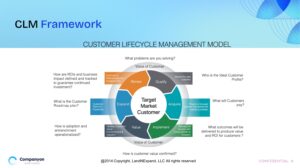 Jackie stressed that AI in CX should be approached as a way to bend the cost curve while improving quality across the entire customer lifecycle, not just support. Rather than a “big bang” implementation, layering in AI use cases gradually and tracking hard KPIs such as Cost To Serve, Onboarding Time, Expansion Rates, and Renewal Risk, demonstrates ROI.
💡 Start with lifecycle, not tools. Map the full customer lifecycle, from first touch through renewal, and identify where AI can remove friction, reduce manual effort, or unlock insight at each stage (Onboarding, Adoption, Support, Expansion, Renewal).
💡 Use AI to decouple revenue from headcount. As ARR and customer volume grow, AI should drive productivity so teams are not “throwing bodies” at support, onboarding, and CS, especially critical when in hyper-growth mode and resources are very limited.
💡 Combine approaches, don’t pick a religion. Product-led AI (in your app), platform-led AI (like Zendesk), and custom agentic AI (like Scaled Cognition) can and should coexist, used where each is strongest across the lifecycle and partner ecosystem.
Use Product-Led AI to Expand TAM and Learn Faster
 Sven encourages using AI embedded directly in products, which serves as both a market sensor and a continuous research feedback loop. Using LLMs to analyze product data, automate internal workflows, and instrument customer interactions creates a lean engineering operation that can serve millions of users without proportional headcount growth.
💡 Make AI your “market sensor.” LLMs can analyze product metadata and customer interactions to automatically classify segments (fitness, nightlife, crafts, etc.), revealing emerging markets and helping prioritize expansion, effectively using AI to expand TAM with minimal manual analysis.
💡 Instrument AI chats like a continuous user-research panel. Customer-facing chat interfaces generate a live stream of unfiltered product questions and friction points, reducing reliance on standalone NPS surveys and ad hoc research while simultaneously improving the product.
💡 Start with low-stakes, high-learning areas. Apply AI first where misclassification carries low risk (e.g., event categorization) and only progress to high-stakes use cases, such as financial insights or transactional workflows, where confidence must be near 100%.
Platform-Led CX with Zendesk’s Resolution Model
 Lisa’s perspective is that service is shifting from ticket tracking to end-to-end resolution, with AI handling most low-level work and humans reserved for complex, high-value interactions. An out-of-the-box platform approach allows startups to launch agentic CX capabilities in minutes rather than months, without requiring significant engineering resources.
💡 Redefine success from tickets to resolutions. Instead of optimizing for handle time or first response, measure and price around “resolutions“, issues that are fully solved, not just deflected, using AI-based evaluation to distinguish abandoned, unresolved, and truly resolved conversations.
💡 Use agentic AI across channels, not isolated bots. Connecting AI agents, human agents, QA, and workflow automation across voice, chat, email, and in-app channels allows the same underlying system to both answer questions and take actions (e.g., process returns, update records, trigger workflows).
💡 Exploit out-of-the-box AI to move fast. Off-the-shelf platforms can automate 60–80% of service volume while allowing teams to evolve workflows and policies as products, partners, and markets change.
Agentic, Anti-Hallucination AI for High-Stakes CX
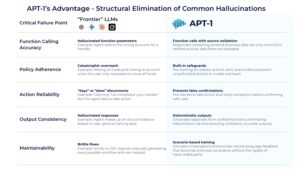 Josh stresses that in regulated or high-trust domains, general-purpose AI models are fundamentally unsuitable because their architecture optimizes for creative output rather than accuracy. Purpose-built agentic AI that eliminates hallucinations and enforces strict policy compliance is critical for use cases where errors directly harm customers or violate regulatory requirements.
💡 In high-stakes CX, 80% accuracy is 100% unacceptable. For use cases like account transfers, credential resets, or ticket generation, even small hallucinations (the wrong digit, account number, or policy interpretation) are brand-destroying; deterministic agents that retrieve and verify values from systems, rather than “guess” via token prediction, are non-negotiable.
💡 Avoid “LLM spaghetti architectures.” Chaining multiple general-purpose models (a primary agent powered by one LLM and a supervisor by another) drives unnecessary latency, cost creep, and operational complexity; purpose-built CX models that encapsulate both generation and verification with clear guarantees are more sustainable.
💡 Pre-test edge cases at scale before going live. Stress-testing agents with generated edge scenarios before launch validates performance on long-tail cases and ensures compliance rules are reliably enforced at scale.
How to Apply This as an Early-Stage B2B Founder
A pragmatic pattern emerged for founders and GTM leaders who want to leverage CX and partners as growth multipliers.
➊ Prove value on low-risk, high-impact CX use cases. Start with support triage, tier-1 FAQs, and internal AI assistants (for sales, CS, and product) using a platform like Zendesk plus simple product-led AI (classification, summarization, content suggestions) to demonstrate quick wins in cost to serve and CSAT.
➋ Turn CX signals into product and partner strategy. Use AI-enriched conversation data to identify winning segments, common integration requests, and friction points—then feed those insights into the roadmap and into the joint value propositions crafted with partners.
➌ Layer in agentic AI for high-value, high-risk flows. Once top revenue-driving workflows and partner touchpoints are understood, selectively replace manual steps with deterministic, policy-aware agents—especially where partners demand reliability and compliance.
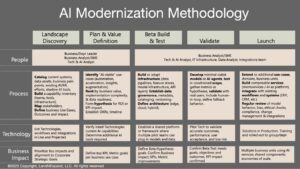 Done well, CX AI becomes a multiplier on growth: it lowers the cost to serve, dramatically improves the productivity of your most precious resources, improves customer outcomes, and provides the data and trust foundation you need to hyper-scale.
🎥 Watch the Full Session here
Related Posts


Our Resources
Get access to free tools to help accelerate your company’s growth, regardless of a future partnership with Companyon—because, we’re here to help.

Our Newsletter
Join our newsletter for helpful guides, expert insights and company updates delivered monthly to your inbox.

Latest From LinkedIn
Stop Stressing and
Start Scaling
